Monastery · Buddhist
Ganden Monastery
དགའ་ལྡན❊Gandan Si / Ganden Namgyeling
Tsongkhapa·Founded 1409 by Tsongkhapa; largely destroyed in the 1960s and rebuilt from the 1980s·Lhasa
The first Gelug monastery and Tsongkhapa's own seat, in a high amphitheatre on Mount Wangbur east of Lhasa — and the trailhead for the Ganden–Samye trek.
Dedicated to
Tsongkhapa
Period
Founded 1409 by Tsongkhapa; largely destroyed in the 1960s and rebuilt from the 1980s
Neighborhood
Mount Wangbur, Dagze — about 45 km east of Lhasa
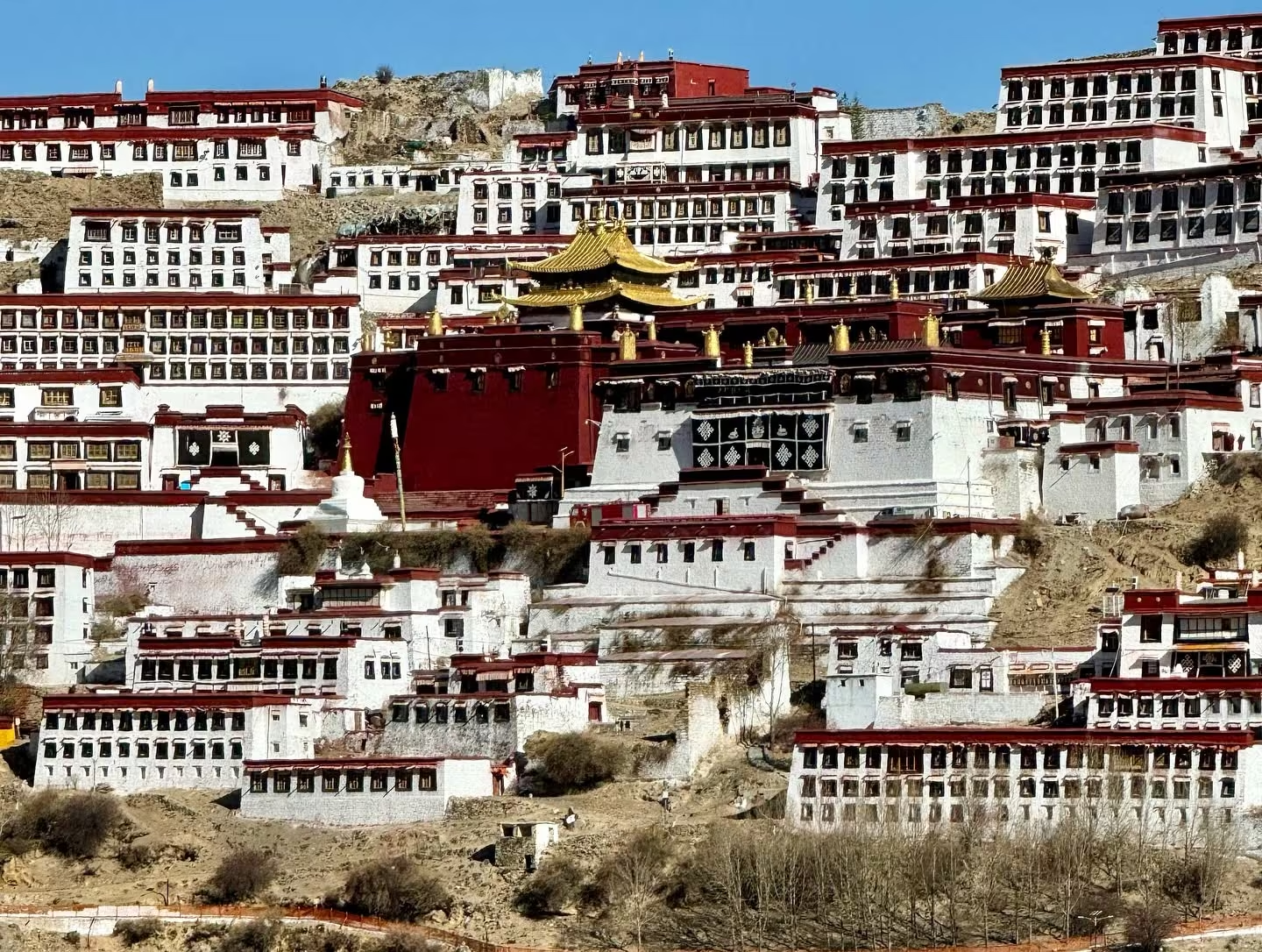
Of the three great Gelug monasteries, Ganden is the one that requires a decision — an hour and a half east of Lhasa, up a series of switchbacks onto the flank of Mount Wangbur, and at around 4,300 metres noticeably higher and harder than Sera or Drepung. It is also the oldest and, for the school, the most important.
Tsongkhapa's monastery
Tsongkhapa — the reformer whose lineage became the Gelug school and, through it, the institution of the Dalai Lamas — founded Ganden in 1409 and died here in 1419. His seat, the Ganden Tripa, remains the formal head of the Gelug school, above the Dalai Lama in that specific institutional sense. This is where the school begins.
What happened here, and what stands
Ganden was very thoroughly destroyed during the Cultural Revolution — more completely than Sera or Drepung — and much of what you walk through today is reconstruction begun in the 1980s, alongside ruins that have deliberately been left as they are. It is a strange and affecting combination, and it is the clearest place in the Lhasa region to see the twentieth century in the fabric of a building rather than in a caption. Tsongkhapa's reliquary chapel was rebuilt and holds a replacement stupa.
The kora and the view
The monastery fills a natural amphitheatre facing the Kyichu valley, and the kora that loops the ridge behind it is the best hour here: prayer flags, rock carvings, sky-burial ground, and a long view down the valley that no photograph of the buildings will give you.
Ganden is also the trailhead of the classic Ganden to Samye trek, four to five days over high passes to Tibet's oldest monastery in the Yarlung valley — the standard walking route of the Lhasa region.
Best visited in autumn.autumn: best, -2°C to 12°C. The best time here by some margin — dry, clear and cold enough to walk comfortably, with the Kyichu valley visible the whole way round. monsoon: good, 5°C to 18°C. The warmest and easiest months for the ridge walk, though cloud can close the valley views that make the kora worth doing. spring: good, -3°C to 11°C. Cold and clear at 4,300 m, with the ridge kora walkable on most days. The mountain road from Lhasa is the constraint rather than the site itself. Permits for foreign travellers have been suspended in some years until late March; it does not happen every year, so confirm the current position before booking March travel. winter: possible, -14°C to 3°C. Severely cold and exposed, and the access road can close after snow. Worth attempting only with a driver who will turn back. Permits for foreign travellers have been suspended in some years from around mid-February; it does not happen every year, so confirm the current position before booking February travel.
The Almanac
The best time here by some margin — dry, clear and cold enough to walk comfortably, with the Kyichu valley visible the whole way round.
Coda
Continue the Pilgrimage
Connects to
Routes and trails that link here
Elsewhere in this region
Help us get it right
Know Ganden Monastery better than we do?
We write from research and reporting, and the ground changes faster than we can keep up. If something here is out of date, or you have been and would tell it differently, we would rather hear it.