Palace · Buddhist
Potala Palace
ཕོ་བྲང་པོ་ཏ་ལ❊Budala Gong
The Dalai Lamas; Avalokiteshvara (Chenrezig)·Begun 1645 under the Fifth Dalai Lama; earlier fortress on the site attributed to the 7th century·Lhasa·UNESCO World Heritage
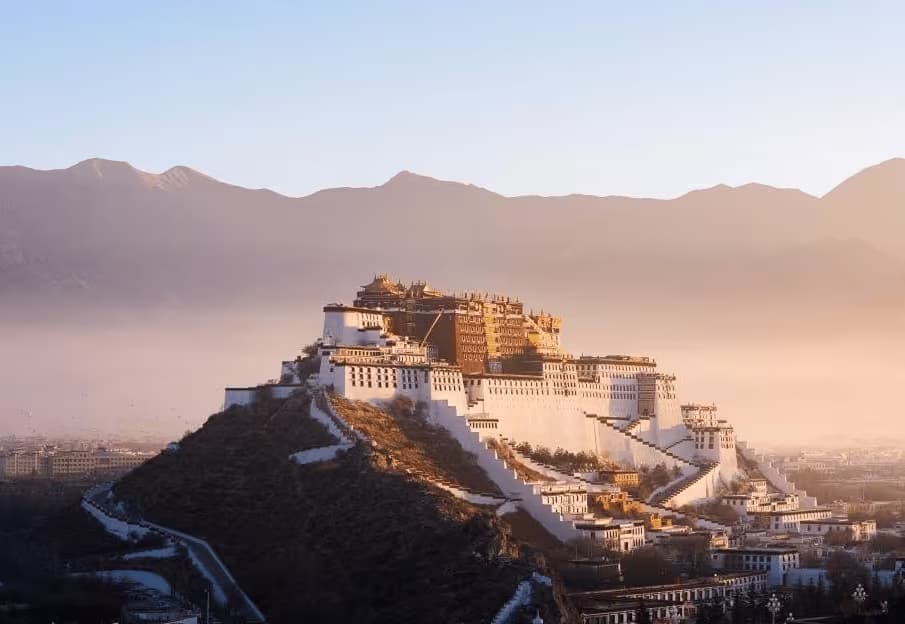
The winter palace of the Dalai Lamas, rising thirteen storeys off Marpo Ri hill above Lhasa — the most recognisable building in the Himalaya.
Dedicated to
The Dalai Lamas; Avalokiteshvara (Chenrezig)
Period
Begun 1645 under the Fifth Dalai Lama; earlier fortress on the site attributed to the 7th century
Neighborhood
Marpo Ri, central Lhasa
The Potala takes up the whole of Marpo Ri, the Red Hill, and it does not look built so much as grown out of it. Thirteen storeys of whitewashed and ox-blood walls step back from the rock in a way that makes the hill and the palace hard to tell apart, and from the square below the roofline sits high enough that you tilt your head to find it.
Two palaces, one building
The White Palace — the outer, lower, paler part — was the administrative and residential half: the Dalai Lama's private apartments, the offices of the Tibetan government, the seminary, the printing house. The Red Palace at the centre is the religious half, and it is where the building stops being architecture and becomes a reliquary. Inside are the stupas of eight Dalai Lamas, the largest of them holding the Fifth, gold-plated and set with turquoise and coral, running some fifteen metres from floor to finial.
The Fifth Dalai Lama's project
Construction began in 1645, under the Fifth Dalai Lama, on a hill that already carried religious weight — tradition puts a fortress of Songtsen Gampo here in the 7th century, and two chapels deep in the Red Palace are held to survive from it. The Fifth had just unified Tibet under Gelug authority, and the Potala is that consolidation in stone: government, monastery and mausoleum in one structure, on the hill above the old city.
It served as the seat of the Tibetan government until 1959. It is now a museum and a UNESCO World Heritage site, inscribed in 1994.
Seeing it
Two views, and they are not the same building. From Barkhor and the old city the Potala is a distant white mass at the end of the street. From the square directly south, or from the small park behind it with the reflecting pool, it fills the frame. Most visitors do the interior circuit in the morning slot their ticket names and come back at dusk for the second view.
Pair it with Norbulingka, the summer palace, a few kilometres west — the two together are the whole shape of how the Dalai Lamas lived through the year, and Norbulingka is by far the more relaxed of the two.
Coda
Continue the Pilgrimage
Help us get it right
Know Potala Palace better than we do?
We write from research and reporting, and the ground changes faster than we can keep up. If something here is out of date, or you have been and would tell it differently, we would rather hear it.